
Female emotions are not random: estrogen, progesterone, stress, and relationship sensitivity
Female emotions are often dismissed as “too much” or “just hormones,” but emotional sensitivity is not random. Estrogen, progesterone, stress, sleep, attachment, relationship safety, and the nervous system can all influence how a woman feels and reacts. This article explains why emotional shifts may become stronger before menstruation, why PMS and PMDD are not the same thing, and how women can work with their bodies instead of shaming their emotional rhythm.
UNDERSTANDING PATTERNS
Alena
5/11/202614 min read
Female emotions are not random: estrogen, progesterone, stress, and relationship sensitivity
Women are often told they are “too emotional.”
Too sensitive.
Too reactive.
Too dramatic.
Too affected.
Too complicated.
Too much.
And when emotions rise, people love to throw one lazy sentence:
“It is just hormones.”
But that sentence is usually not understanding.
It is dismissal.
Because yes, hormones can influence emotions. But that does not mean female emotions are fake, irrational, or meaningless.
A woman’s emotional world is not random.
It is layered.
Body chemistry matters. Stress matters. Sleep matters. Attachment matters. Relationship safety matters. Past experiences matter. Current environment matters. Timing matters. The nervous system matters. The meaning of the relationship matters.
So when a woman feels more sensitive, more reactive, more needy, more emotional, more tired, more easily hurt, or more deeply affected, the question should not only be:
“What is wrong with me?”
A better question is:
“What is happening in my system right now?”
Because sometimes the emotion is not coming from one place.
Sometimes it is your body, your hormones, your stress level, your attachment system, your unmet needs, and your relationship environment all speaking at the same time.
[connect to existing link: layered human system framework]
Hormones can influence emotions, but they do not erase truth
Let’s be clear from the beginning.
Hormones can influence mood, energy, sensitivity, cravings, sleep, stress tolerance, and emotional regulation. PMS can include emotional symptoms such as anxiety, irritability, mood swings, sleep problems, appetite changes, and difficulty concentrating.
But hormones do not automatically make your feelings meaningless.
This is where many women get gaslighted, and sometimes they gaslight themselves.
They think:
“Maybe I am only upset because my period is coming.”
“Maybe I am only sensitive because of hormones.”
“Maybe I should ignore this feeling.”
“Maybe I am overreacting.”
But the better question is not:
“Is this hormones or truth?”
Sometimes it is both.
Hormones can turn the volume up on something that was already there.
Maybe the relationship already felt unsafe, but now your body has less capacity to tolerate it.
Maybe the issue already hurt you, but now your emotional skin feels thinner.
Maybe you were already exhausted, but now your stress response is louder.
Maybe you were already craving reassurance, but now your body is more sensitive to distance.
So instead of dismissing the feeling, you can ask:
“What is the feeling pointing to?”
Is it pointing to a real need?
A real boundary?
A real insecurity?
A real lack of safety?
A real exhaustion?
A real pattern in the relationship?
The timing may explain the intensity.
But it does not automatically cancel the message.
A simplified hormone map
When people talk about female hormones, they often focus only on estrogen and progesterone. But the body is not that simple.
A woman’s emotional and physical state can also be influenced by stress hormones, thyroid function, sleep, blood sugar, reproductive hormones, and bonding chemistry.
For example, LH and FSH help regulate ovulation and the menstrual cycle. Prolactin is connected to milk production and can interact with reproductive function. Oxytocin is connected to bonding, closeness, childbirth, and breastfeeding. TSH signals the thyroid gland, which affects metabolism, energy, body temperature, and mood. Cortisol is connected to stress response and energy regulation.
This matters because when a woman feels emotionally different, tired, anxious, sensitive, disconnected, or overwhelmed, it may not be “just mood.”
It may be the whole system speaking.
That does not mean every feeling needs a medical explanation. But it does mean we should stop treating female emotions as random drama. The body is layered, and emotions often appear where biology, stress, environment, attachment, and relationship safety meet.
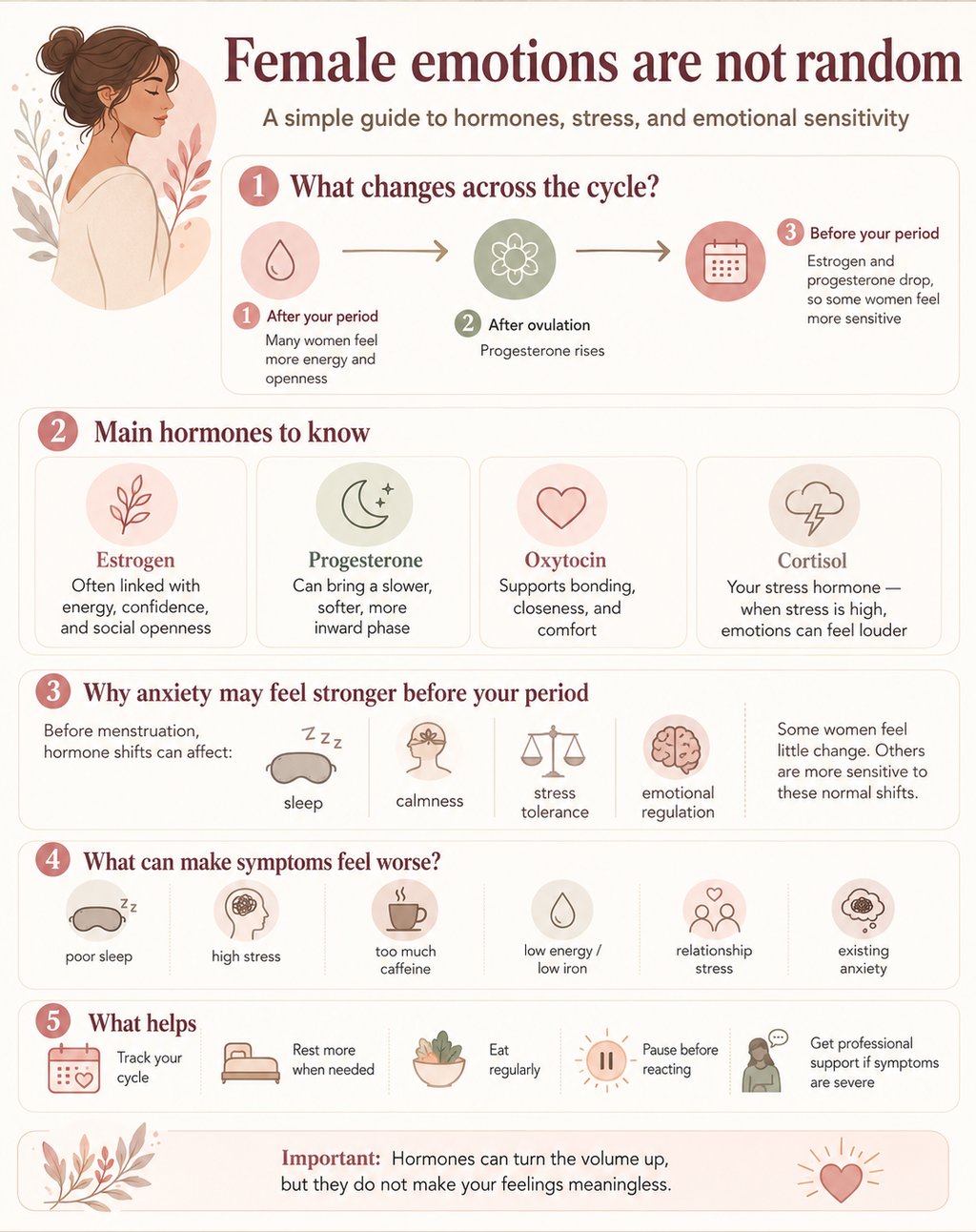
Figure caption for image:
This infographic summarizes the main message of the article in a simple visual way: female emotions are influenced by cycle changes, hormones, stress, sleep, relationship pressure, and the body’s capacity to regulate. It can be used as a quick reader-friendly guide to show that emotional sensitivity is not random or meaningless - it often reflects the whole body system responding at once.
[connect to existing link: layered human system framework]
Estrogen: energy, openness, and emotional brightness
Estrogen is often associated with the first half of the menstrual cycle, especially as it rises before ovulation.
For many women, higher estrogen phases may feel like more energy, more confidence, more sociability, more desire, better mood, clearer thinking, or stronger motivation.
This does not happen perfectly for everyone, and women are not machines with identical cycles.
But many women do notice that some days they feel more open to life.
They want to dress up.
Talk more.
Create more.
Connect more.
Flirt more.
Be seen more.
Move more.
Plan more.
Express more.
This is one reason self-awareness matters.
If you understand that your body has rhythms, you stop expecting yourself to feel the same every day.
You may begin to notice:
“When do I feel most confident?”
“When do I feel most social?”
“When do I feel most creative?”
“When do I feel most emotionally open?”
“When do I feel more interested in connection or attraction?”
This kind of self-observation is not about becoming obsessed with hormones.
It is about becoming literate in your own body.
Because when you understand your rhythm, you can work with yourself instead of constantly fighting yourself.
[connect to existing link: What your cravings naturally mean: dopamine, serotonin, cortisol]
Progesterone: slowing down, protection, and emotional sensitivity
Progesterone rises after ovulation during the luteal phase. Closer to menstruation, progesterone and estrogen drop, and for some women this shift can affect emotional regulation, sleep, stress tolerance, and sensitivity.
This is not because women are “irrational.”
It is because some nervous systems are more sensitive to normal hormonal fluctuations.
For some women, the luteal phase can feel calmer, softer, more inward, more reflective, or more nurturing.
For others, especially if stress is high or hormonal sensitivity is strong, the same phase can bring irritability, sadness, anxiety, low energy, food cravings, sleep changes, or stronger emotional reactions.
This is the phase where many women start asking:
“Why am I suddenly sensitive?”
“Why do I need more reassurance?”
“Why do I feel irritated by everything?”
“Why do I want to hide from people?”
“Why do I suddenly question my whole relationship?”
The answer is not always simple.
Sometimes your body genuinely needs more rest.
Sometimes your stress tolerance is lower.
Sometimes unresolved relationship issues become harder to ignore.
Sometimes your nervous system has less patience for emotional uncertainty.
Sometimes your body is asking for protection, quiet, food, sleep, warmth, and less pressure.
This is why pushing yourself the same way every day can backfire.
If your body is in a more sensitive phase, forcing yourself to perform at full power while also handling emotional stress, relationship uncertainty, poor sleep, and overthinking can make everything feel heavier.
The solution is not to blame progesterone.
The solution is to listen more intelligently.
What is my body asking for?
What is my relationship environment doing to my nervous system?
What do I need more of this week?
Rest? Clarity? Reassurance? Space? Food? Movement? Less conflict? Less social pressure? Better sleep?
Female self-care is not only skincare and candles.
Sometimes it is knowing when your system has less capacity and refusing to treat yourself like a machine.
The luteal phase can make existing anxiety louder
Many women notice that anxiety becomes stronger before menstruation.
This does not mean the anxiety is fake.
It may mean the body has entered a phase where the nervous system becomes more sensitive to hormonal shifts.
After ovulation, progesterone rises. Later, closer to menstruation, progesterone and estrogen drop. These natural changes can influence systems connected to mood regulation, sleep, stress tolerance, calmness, and emotional stability.
One important substance here is allopregnanolone, a metabolite of progesterone that interacts with the brain’s calming systems. Research connects allopregnanolone, progesterone, and GABA-related brain systems with premenstrual mood symptoms in sensitive individuals.
In some women, these shifts are processed smoothly. In others, especially those who are more sensitive to hormonal fluctuations, the same phase can bring stronger anxiety, irritability, insomnia, emotional heaviness, or panic-like symptoms.
This is why the luteal phase can feel different from the rest of the month.
But hormones are not the whole story.
If the nervous system is already overloaded - because of poor sleep, chronic stress, emotional uncertainty, too much caffeine, low energy, possible low ferritin, unresolved anxiety, or relationship instability - then the premenstrual phase may turn the volume up on what was already there.
This is why it is important to distinguish between PMS, PMDD, and premenstrual worsening of an existing anxiety pattern.
PMS can bring emotional and physical symptoms before menstruation. PMDD is more severe and can seriously affect daily functioning, often improving within a few days after menstruation begins.
Premenstrual exacerbation means that an existing condition, such as anxiety or depression, becomes worse before menstruation. This is different from symptoms appearing only in the premenstrual phase.
So instead of dismissing yourself with “I am just hormonal,” ask:
What is my body reacting to?
What was already stressful before this phase?
Is this a monthly pattern?
Does it improve after my period starts?
Is this affecting my ability to function?
Do I need medical or psychological support?
This kind of awareness is powerful because it helps you stop blaming yourself and start reading your body more accurately.
Your cycle may not create every problem.
But it can reveal which problems your body no longer has capacity to carry silently.
Stress can make everything louder
Stress changes emotional sensitivity.
When your body is already carrying pressure, you have less room for relationship chaos.
This is where cortisol enters the picture.
Cortisol is one of the body’s major stress hormones. It helps the body respond to pressure, but when stress is high or prolonged, emotional regulation can become harder.
So if a woman is already stressed, tired, underfed, overworked, sleeping badly, emotionally unsupported, or living in uncertainty, her relationship reactions may become stronger.
Not because she is “crazy.”
Because her system is loaded.
A small message can feel huge.
A delayed reply can feel like rejection.
A cold tone can feel like abandonment.
A minor conflict can feel like collapse.
A lack of reassurance can feel unbearable.
This does not mean every reaction is objectively accurate.
But it does mean the reaction is coming from a body that may already be under pressure.
And this is where self-leadership matters.
Instead of asking: “Why am I like this?”
Ask: “What is my current capacity?”
Have I slept?
Have I eaten properly?
Have I been under pressure?
Have I been emotionally activated for days?
Am I close to my period?
Am I lonely?
Am I overstimulated?
Am I trying to tolerate something that has been hurting me for too long?
Sometimes the problem is not that one small thing happened.
Sometimes the small thing touched a system that was already full.
[connect to existing link: Your hormones are not your destiny: how to work with your body without obeying every craving]
Relationship sensitivity is not always weakness
Some women are highly sensitive to relational energy.
A shift in tone.
A delay in response.
A change in affection.
A different facial expression.
A new distance.
A lack of warmth.
A strange silence.
They feel it quickly.
And because society often mocks female sensitivity, many women start shaming themselves for noticing.
But sensitivity itself is not the enemy.
Sensitivity can be intelligence.
It can help you detect changes in emotional atmosphere.
It can help you sense when something is off.
It can help you recognize disconnection before it becomes obvious.
It can help you notice what is unspoken.
The problem is not sensitivity.
The problem is when sensitivity becomes panic.
There is a difference between:
“I notice a shift.”
And:
“This shift means I am about to be abandoned, so I must react immediately.”
The first is awareness.
The second is nervous system activation.
Emotional maturity means you learn to pause between noticing and reacting.
You do not shame the sensitivity.
You refine it.
You ask:
“What did I notice?”
“What story did my mind create?”
“What evidence do I have?”
“What do I need?”
“What is the best way to communicate this without attacking, begging, or collapsing?”
That pause is powerful.
Because it turns sensitivity into wisdom.
[connect to existing link: Why you overthink everything and can’t stop]
The cycle can reveal what you have been suppressing
Many women notice that before their period, the truth becomes harder to avoid.
Things they tolerated two weeks ago suddenly feel unbearable.
A relationship issue they tried to ignore becomes loud.
A need they minimized starts demanding attention.
A boundary they avoided starts burning inside the body.
This does not mean the premenstrual phase creates fake problems.
Sometimes it reveals what you have been carrying silently.
The emotional filter becomes thinner.
The body has less energy for performance.
The polite mask slips.
The “I am fine” becomes less convincing.
And suddenly you hear the truth underneath:
“I am tired.”
“I need more support.”
“I do not feel safe here.”
“I am not being heard.”
“I am doing too much.”
“I miss softness.”
“I need clarity.”
“I am angry because I keep abandoning myself.”
This is why female emotional rhythm can become a source of self-knowledge.
But only if you stop treating it as an inconvenience.
Instead of saying:
“I hate this version of me,”
Try asking:
“What does this version of me refuse to fake?”
That question can change everything.
Do not make permanent conclusions from a temporary state
Now, let’s balance the conversation.
Just because emotions are meaningful does not mean every emotional wave should become a final decision.
If you are exhausted, stressed, sleep-deprived, hormonally sensitive, or emotionally activated, be careful with big conclusions.
Do not decide your whole relationship is doomed because you had one intense emotional night.
Do not send the paragraph while your body is in panic.
Do not break up, confess, accuse, expose, or test someone just because your nervous system is screaming for relief.
First regulate.
Then reflect.
Then communicate.
Then decide.
This does not mean you ignore the feeling.
It means you respect the feeling enough to handle it properly.
A feeling can be valid and still need time before action.
This is emotional leadership.
Not suppression.
Leadership.
You can write the message in notes first.
You can sleep on it.
You can eat first.
You can pray first.
You can take a walk.
You can ask:
“Will I still feel this way tomorrow?”
“What exactly triggered me?”
“What is the need under this reaction?”
“What is the pattern, not just the moment?”
This is how you protect your life from impulsive decisions without silencing your inner truth.
How to track your emotional rhythm without becoming obsessed
One practical way to understand yourself is to track your emotional rhythm.
Not in a perfectionist way.
Just gently.
For two or three months, notice:
When do I feel most confident?
When do I feel most emotionally sensitive?
When do I crave more reassurance?
When do I feel more sexual, social, creative, or withdrawn?
When do I overthink more?
When do I want to isolate?
When do relationship problems feel louder?
When do I need more food, sleep, softness, or space?
You may begin to see patterns.
Maybe you feel more powerful after your period.
Maybe you feel more open around ovulation.
Maybe you feel more inward before menstruation.
Maybe stress makes your luteal phase harder.
Maybe relationship uncertainty becomes unbearable when your body is already tired.
This is not about reducing yourself to a cycle.
It is about understanding your timing.
Because when you know your patterns, you can prepare.
You can avoid unnecessary conflict when you are overloaded.
You can ask for reassurance before you explode.
You can reduce social pressure when your body needs quiet.
You can schedule demanding work when your energy is stronger.
You can stop calling yourself lazy when your body is asking for rest.
You can stop calling yourself dramatic when your sensitivity has a pattern.
Self-knowledge makes self-care more precise.
[connect to existing link: Why your body craves connection: oxytocin, endorphins, and emotional bonding]
A woman’s body needs safety, not constant pressure
A lot of modern women are expected to be everything all the time.
Productive.
Beautiful.
Emotionally stable.
Sexually available.
Mentally sharp.
Socially pleasant.
Spiritually grounded.
Professionally ambitious.
Calm in conflict.
Soft but strong.
Independent but romantic.
Understanding but not needy.
And then when the body reacts, people say:
“Why are you so emotional?”
Maybe because the system is overloaded.
Maybe because the body is tired of pretending.
Maybe because the woman has been functioning without enough support.
Maybe because she has been holding too much, for too long, with too little care.
Female emotional sensitivity should not always be treated as a defect.
Sometimes it is a signal that the current lifestyle or relationship structure is not supporting the body properly.
The question becomes:
Does my life give my body enough safety?
Does my relationship give my nervous system enough clarity?
Does my routine give me enough recovery?
Does my environment support regulation, or does it constantly activate me?
Because a woman cannot regulate well inside a life that keeps dysregulating her.
That is not weakness.
That is biology meeting environment.
[connect to existing link: The matrix of love, Alena PsyCrafter signature framework]
How to communicate emotional sensitivity without blaming
In relationships, emotional sensitivity needs expression, not explosion.
Instead of saying:
“You always make me feel crazy.”
Try:
“I notice I feel more sensitive today, and I need a little reassurance.”
Instead of:
“You do not care about me.”
Try:
“When communication becomes distant, I start feeling unsafe. Can we talk clearly?”
Instead of:
“You ruined my mood.”
Try:
“I am already overwhelmed today, so I need us to speak gently.”
Instead of:
“If you loved me, you would know.”
Try:
“What I need right now is clarity and warmth.”
This matters because emotional truth becomes easier to receive when it is communicated with ownership.
Ownership does not mean blaming yourself.
It means you can say:
“This is what I feel.”
“This is what I notice.”
“This is what I need.”
“This is the pattern I want to discuss.”
This is how sensitivity becomes relational intelligence.
Not accusation.
Not silence.
Not testing.
Not passive aggression.
Clear emotional communication.
That is where intimacy grows.
When emotional symptoms need professional support
Most women experience some emotional changes across life stages, stress cycles, or menstrual phases.
But if your mood symptoms are severe, if you feel unable to function, if your relationships, work, sleep, appetite, or daily responsibilities are significantly affected, or if emotional changes feel extreme and recurring, it is worth speaking with a qualified healthcare professional.
This is not because you are weak.
It is because your body may need proper support.
There are conditions like PMS and PMDD, and there are also many other factors that can affect mood, including stress, thyroid function, sleep problems, trauma, anxiety, depression, nutrition, medication, and life pressure. PMDD is considered more severe than typical PMS and can interfere significantly with everyday life.
Do not self-diagnose everything as “hormones.”
And do not ignore your body when it is clearly asking for help.
Support can be medical, psychological, lifestyle-based, relational, or spiritual — depending on what is actually happening.
The point is not to panic.
The point is to take your body seriously.
Final thought
Female emotions are not random.
They are not always convenient, but they are not meaningless.
Sometimes they are shaped by estrogen, progesterone, cortisol, allopregnanolone, sleep, stress, attachment, unmet needs, relationship uncertainty, and the environment around you.
Sometimes hormones turn the volume up.
Sometimes stress makes the body more reactive.
Sometimes the cycle reveals what you have been suppressing.
Sometimes emotional sensitivity is not the problem.
Sometimes it is the messenger.
The goal is not to obey every emotional wave.
And the goal is not to dismiss every emotional wave either.
The goal is to understand yourself deeply enough to know the difference.
Feel the emotion.
Respect the body.
Check the timing.
Read the pattern.
Regulate before reacting.
Communicate with clarity.
And choose from your deeper self.
Because being emotional does not make a woman unstable.
But refusing to understand her emotional system can make her life unstable.
Your sensitivity is not something to hate.
It is something to learn how to lead.
If you want to go deeper
Understanding patterns
What your cravings naturally mean: dopamine, serotonin, cortisol
A useful starting point for understanding how cravings, mood, stress, reward-seeking, and emotional urges are connected to body chemistry.
Why your body craves connection: oxytocin, endorphins, and emotional bonding
A softer article on why the body craves closeness, touch, warmth, bonding, and emotional safety.
Why attraction can feel addictive: dopamine, oxytocin, cortisol, and the trauma bond loop
A deeper article on why unstable attraction can feel chemically intense when reward, bonding, stress, and relief become mixed together.
Why attraction can feel stronger when someone is inconsistent
An article about unpredictable attention, intermittent reinforcement, and why inconsistency can make attraction feel stronger than stable love.
Your hormones are not your destiny: how to work with your body without obeying every craving
A practical article about emotional self-leadership, body awareness, and learning how to respect cravings without letting them control your choices.
Relationship
The matrix of love, Alena PsyCrafter signature framework
A framework for understanding why love, attraction, sex, attachment, fantasy, and relationship structure happen across different layers.
Layered human system framework
A broader framework for understanding the human being through multiple layers, including body, emotions, cognition, behaviour, identity, environment, and relationship patterns.
Why you overthink everything and can’t stop
A useful follow-up if emotional sensitivity turns into rumination, checking, replaying conversations, or trying to solve uncertainty through thinking.
What love actually is and why most people get it wrong
A broader article explaining why love is not only a feeling, but a layered experience involving body, needs, action, understanding, and relationship reality.